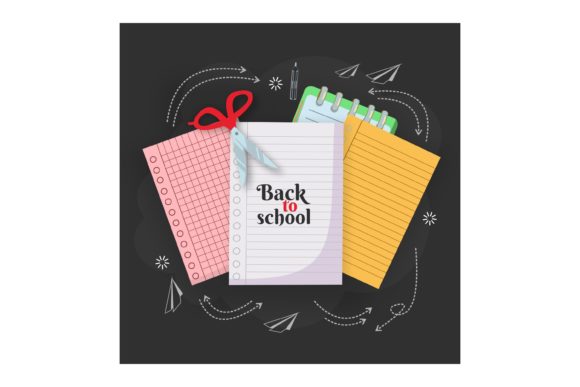
Back to School with Paper and Notebook Vector Graphics: A Designer’s Guide to Versatile EPS Assets
Every year, as summer winds down, designers, educators, and content creators scramble to refresh their visual libraries for the back-to-school season. Whether you are producing classroom materials, promotional flyers, social media templates, or e‑learning modules, having a reliable set of graphic assets can make all the difference. That is where Back to School with Paper and Notebook and – VECTOR EPS comes into play. These vector files offer a level of flexibility and polish that raster images simply cannot match. With fully editable typography, well‑organized shapes, and high‑resolution output, they are built to streamline your workflow and elevate your projects.
This article explores what makes these vector graphics indispensable, how they integrate into modern design pipelines, and what you should consider before choosing a set for your next project. Whether you are a seasoned creative professional or a teacher looking to design your own handouts, understanding the features and practical benefits of these assets will help you get the most out of them.
What Makes Vector EPS Graphics Ideal for Back‑to‑School Projects?
Vector graphics are fundamentally different from raster images. Instead of storing color information in a fixed grid of pixels, they use mathematical equations to define shapes, lines, and curves. This core difference gives vector files several advantages that are especially valuable in a back‑to‑school context.
Infinite Scalability Without Quality Loss
One of the most practical benefits is that you can scale a vector illustration up or down without ever worrying about pixelation or blurriness. A notebook icon designed at a small size can be enlarged to fill a poster without losing crispness. This is critical when you need one set of graphics to work across multiple formats—from a tiny thumbnail on a school website to a large banner in a gymnasium. The Back to School with Paper and Notebook assets are built with this scalability in mind, so you can resize them confidently for any application.
Fully Editable Typography and Shapes
The phrase “Fully Editable Typography” is more than a marketing tagline. It means that every text element included in the file remains live and adjustable. You can change the wording, the font face, the size, the color, and even the tracking and leading without having to recreate anything from scratch. The same principle applies to shapes and illustrations. Because all objects are well organized in layers and groups, you can select any element—a pencil, a binder, a sheet of lined paper—and modify it independently. If your school’s branding requires a specific shade of blue, you can update every graphic element to match in seconds.
RGB Color Mode for Digital First Workflows
Modern design often begins and ends on screens. RGB (Red, Green, Blue) is the color model used by monitors, tablets, and projectors. By providing these graphics in RGB color mode, the creators ensure that the colors you see on your display are vibrant and accurate. Whether you are designing a presentation that will be shown on a smartboard or a social media graphic viewed on phones, RGB mode helps maintain consistency and visual impact.
Who Benefits from These Vector Assets?
The versatility of Back to School with Paper and Notebook and – VECTOR EPS makes them suitable for a wide range of users, not just professional graphic designers. Understanding who typically reaches for these files can help you see where they might fit into your own routine.
- Teachers and Educators: Creating worksheets, bulletin board decorations, lesson slides, and classroom handouts becomes faster when you start with professionally designed vector elements. You can edit text to include your own lesson content, change colors to match your classroom theme, and print at any size.
- School Administrators and Marketing Teams: Newsletters, enrollment brochures, website banners, and event flyers all benefit from a cohesive visual language. Vector assets make it easy to maintain brand consistency across print and digital materials.
- Freelance Designers and Creative Agencies: When a client requests a back‑to‑school campaign with a tight deadline, having a flexible set of vector graphics in your toolkit can save hours of work. You can customize every detail and deliver high‑resolution files without starting from zero.
- Homeschooling Parents and Tutors: Many parents now create their own learning materials at home. Vector graphics let you design custom reading logs, reward charts, and subject‑specific worksheets that look polished and engaging.
- Content Creators and Influencers: Bloggers, YouTubers, and social media managers covering educational topics or parenting often need seasonal visuals. Editable vector files allow you to produce unique thumbnails, pins, and posts that stand out.
Key Qualities to Look for in Back‑to‑School Vector Graphics
Not all vector files are created equal. When evaluating a set like Back to School with Paper and Notebook, several characteristics determine how useful and time‑saving they will actually be.
Organized Layers and Grouping
Well‑organized shapes are not just a convenience; they are a necessity for efficient editing. Files that come with clear layer names, grouped elements, and logical hierarchies allow you to find and modify specific parts without hunting through dozens of unnamed paths. Look for assets where objects are grouped by type—for example, all notebook pages in one folder, all pencils in another, and all text layers clearly labeled. This structure speeds up your workflow and reduces frustration.
Compatibility with the Graphic Style Panel
One feature that experienced Illustrator users appreciate is when vector files are set up to work seamlessly with the Graphic Style panel. This means you can apply pre‑saved style attributes—like drop shadows, gradients, or strokes—across multiple objects in one click. When an asset is described as “ready to use on Graphic Style panel,” it indicates that the paths are clean, the fills and strokes are consistent, and the file is optimized for non‑destructive editing. This can dramatically speed up applying a cohesive look to an entire set of illustrations.
High‑Resolution Output
“High‑resolution” in the context of vectors refers to the output capability rather than the file itself. Because vectors are resolution‑independent, they can be exported at any DPI (dots per inch) without interpolation. A high‑resolution file ensures that when you export to PDF, TIFF, or PNG at 300 DPI for print, every line remains razor‑sharp. For classroom posters or printed handouts, this level of quality is essential.
Sample Preview in JPEG
While not a functional feature, a sample preview in JPEG is incredibly helpful when browsing and selecting assets. It lets you see exactly what is included in the set before you open it in Illustrator. This transparency saves time and helps you confirm that the style matches your project’s needs.
Practical Applications in Modern Workflows
Understanding how these graphics function inside a real‑world design process can illustrate their value more concretely. Let’s walk through a few common scenarios.
Scenario 1: Designing a Classroom Newsletter
You need to create a monthly newsletter for parents. With Back to School with Paper and Notebook vector files, you can open the EPS in Adobe Illustrator and immediately see layers for notebook paper backgrounds, sticky note shapes, a pencil illustration, and a chalkboard frame. You decide to use a lined‑paper background as the base. You adjust the color of the lines to match your school’s light blue branding. You then drag in a text box for the principal’s message, using one of the editable typography styles included. Because the text is fully editable, you simply type over the placeholder. You export the final file as a high‑resolution PDF for printing and a JPEG for email distribution. The entire process takes less than an hour.
Scenario 2: Creating Social Media Templates for a School District
Your school district wants a series of Instagram and Facebook posts for “Week of Welcome.” You need consistent visuals for each day of the week. Using the vector set, you select a composition featuring a notebook, a coffee cup, and an apple. You duplicate the artboard five times. On each, you change the headline using the editable typography layer—Monday through Friday. You also adjust the color of the apple to match the daily theme. Because all objects are editable, you can experiment freely without breaking the design. The RGB color mode ensures that the vibrant colors you choose on screen will appear correctly on mobile devices.
Scenario 3: Building a Custom Worksheet Set for a Homeschool Curriculum
As a homeschooling parent, you want math practice sheets that feel inviting to your child. You open the EPS file and locate a blank notebook page graphic. You add your own math problems using the live text feature. You then duplicate the page and change the background color for different difficulty levels. The well‑organized shapes let you quickly hide the decorative elements that are not needed for the worksheet, leaving a clean, focused layout. You print at home on standard letter paper, and because the vectors are resolution‑independent, the lines and text come out crisp even on a basic printer.
What to Consider Before Choosing a Vector Set
While the benefits are substantial, there are a few practical considerations that can help you select the right asset pack for your needs.
Font Compatibility
Most vector sets like this one specify “Font not included.” This is standard practice in the industry. The editable typography layers use common system fonts or free alternatives, but if the original font used in the preview is not installed on your computer, Illustrator will prompt you to substitute it. Always check what fonts are used in the preview and ensure you have access to them or have a suitable replacement ready. The beauty of fully editable typography is that you can switch to any font you prefer without any difficulty.
Software Requirements
These files are specifically designed for Adobe Illustrator. While other vector editing applications may open EPS files to some extent, the full set of features—including the Graphic Style panel integration, organized layers, and non‑destructive editing—are best experienced in Illustrator. If you are using a different program, verify compatibility ahead of time.
Intended Use and Licensing
Consider where and how you plan to use the graphics. Are you creating materials for a single classroom, a district‑wide campaign, or a commercial product? Always review the license agreement that comes with the vector set. Many educational and personal use licenses are generous, but commercial or resale applications may require an extended license.
Observations on Workflow Efficiency
One of the most underappreciated aspects of a well‑crafted vector set is how it affects your creative momentum. When you can jump straight into customization instead of drawing basic shapes from scratch, you preserve mental energy for the higher‑level decisions—layout, messaging, and visual hierarchy. The Back to School with Paper and Notebook files are structured to minimize friction. The layers are named intuitively, the objects are grouped logically, and the graphic styles are applied consistently. This attention to detail means less time clicking through menus and more time refining your design.
Another observation from frequent use is the value of consistency. When all the illustrations in a set share the same stroke weights, color palette, and stylistic approach, your final composition feels coherent. Mixing assets from different sources can lead to a disjointed look. Using a single, well‑curated vector pack ensures that every element—from the notebook spiral to the pencil eraser—belongs together visually.
Final Thoughts on Choosing Vector Graphics for School Projects
The back‑to‑school season is busy enough without struggling with subpar design assets. Vector EPS files that offer editable typography, organized shapes, RGB color mode, and high‑resolution output provide a solid foundation for almost any project. Whether you are a teacher preparing next week’s lesson, a designer producing a campaign, or a parent creating homeschool materials, the ability to customize every detail gives you control over the final result.
By understanding the qualities that matter—layer organization, font flexibility, software compatibility, and scalability—you can select a set that truly supports your workflow. And when you find one like Back to School with Paper and Notebook and – VECTOR EPS that checks all those boxes, you can spend less time fighting with files and more time creating something that resonates with your audience. The right vector assets do not just save time; they raise the quality of everything you produce.